
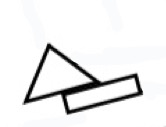
The quality (type) of a turn is shown by the ball in the inclinometer. This is the curved glass tube of the turn coordinator (or turn and slip), the simulacrum of that tube in some electronic displays, or the primary flight display’s (PFD) sliding triangle sky-pointer base in others (Figure 1).
Figure 1.
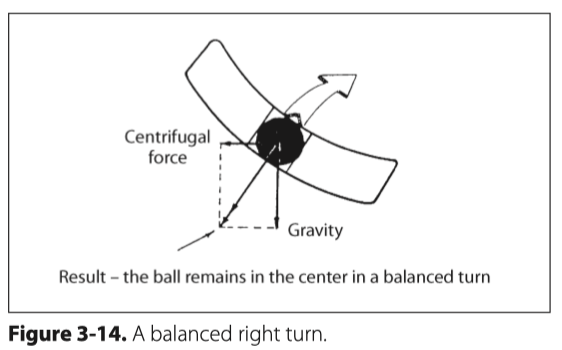
In a balanced turn, the ball will stay between the reference lines (Figure 3-14, The Student Pilot’s Flight Manual, 11th Edition) or the base will be lined up centered in the triangular display. Centrifugal force is offsetting gravity to give a force to the pilot (and the ball) that is symmetrical to the airframe. In other words, the force is downward to the belly of the plane, directly into the seat, not to the inside of the turn or to the outside. The airplane is turning efficiently.
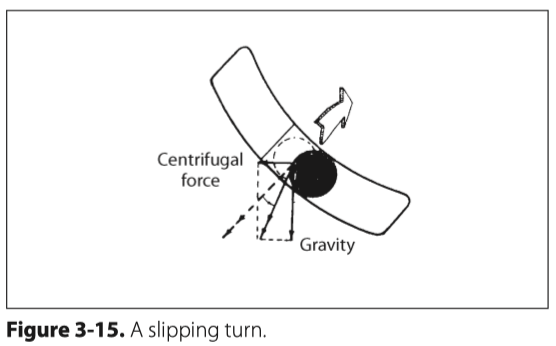
In a slipping turn (Figure 3-15), the bank exceeds that needed for the rate of turn (if any), so gravity overrides centrifugal force and pulls the ball (and the pilot) to the inside of the turn. This maneuver is maintained by holding rudder against the bank (or, say, not enough right rudder in a climbing right turn), so that the nose is pointing some amount away from the direction of the bank. The airplane is flying through the air with the banked side facing more forward than ideal, creating drag. The plane may be changing heading or the slip might be so strong as to maintain heading while in a pretty good bank (there’s bank, but no yaw due to the opposite rudder). This may be intentional. See the Post from May 14, 2025 for more about slips.
The third type of turn is the skid. When you have too much heading change for the particular bank angle, you are skidding (Figure 3-16) and the ball of the inclinometer moves to the outside of the turn. A skid doesn’t feel way out of the ordinary for a beginning pilot, since all turns in a car give this “to the outside” feeling.
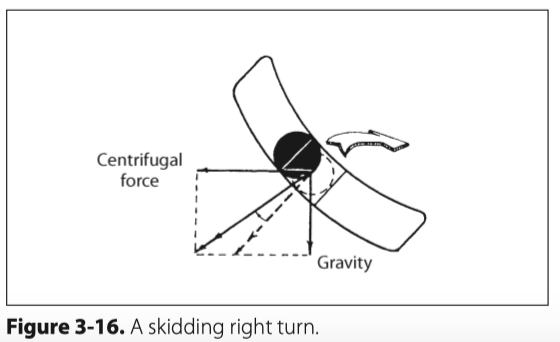
The skid is the problem in the classic cross-control stall, the probable origin of the dark phrase, “stall, spin, crash, and burn.”
Here’s how it might come about: the pilot overshoots final (tailwind on base is a common reason). Since steep banks close to the ground is considered aerodynamically impolite, inside rudder is added to slide that old nose around toward the runway. The airplane is already in a bank, which means that inside rudder pulls the nose toward the ground and also tends to steepen the bank. We can’t have that, so some pulling is done on the yoke or stick and a bit of opposite aileron is added to keep the bank from steepening further. The fact that the inside wing has effectively had its AOA increased (by being “moved back” in the air compared to the outside wing) AND now has a down aileron (which, like a flap, reduces its critical angle of attack), means that it is much closer to a stall and may indeed stall. If it stalls, the airplane instantly rolls over onto its back and beyond and, at 400’ AGL, there is no recovery possible. In a left base to final turn, the flight data recorder recovered from the wreckage would show up elevator, left rudder, and right aileron just before the stall break. The turn coordinator would show a left turn, but the ball would be out to the right due to the skid. These accidents might be even more common, except that the airplane is descending, so is somewhat “unloaded”. Doing a cross-control stall, while attempting to hold altitude could be interesting indeed. Remember that a required part of a spin entry is yaw in the form of full rudder.
In the final analysis:
Coordinated turns (just the right amount of rudder to the amount of aileron): ~99.5% of turns.
Slips: a very small percentage of flight, used either to lose altitude or to offset a crosswind component when landing.
Skids: no socially redeeming value in flying.
If you overshoot final, go-around. And you should practice go-arounds often.
There’s the old saying of “flying by the seat of your pants”. Some of us who aren’t very coordinated with the rudder have pants that are shiny indeed from sliding around on the seat cushion, moving to the inside in slips and the outside in skids, sometimes accompanied by a faint “tink” as the ball reaches the end of the tube.
A note about the sky-pointer in Figure 1: pretend that the slider at the bottom is your beloved dog and it’s raining. Since the hound becomes rather smelly when wet, the answer is to use your foot to gently push the dog back under its “house” and out of the rain. Gentle pressure on the right rudder pedal would fix the issue shown.


