
A quick review of trigonometry (“triangle measure”) and the properties of triangles might be helpful before looking at crab angles.
The sum of three interior angles of every triangle equals 180°, for example, 45/45/90, 30/60/90, 60/60/60, and even a long and lean 2/89/89 triangle.
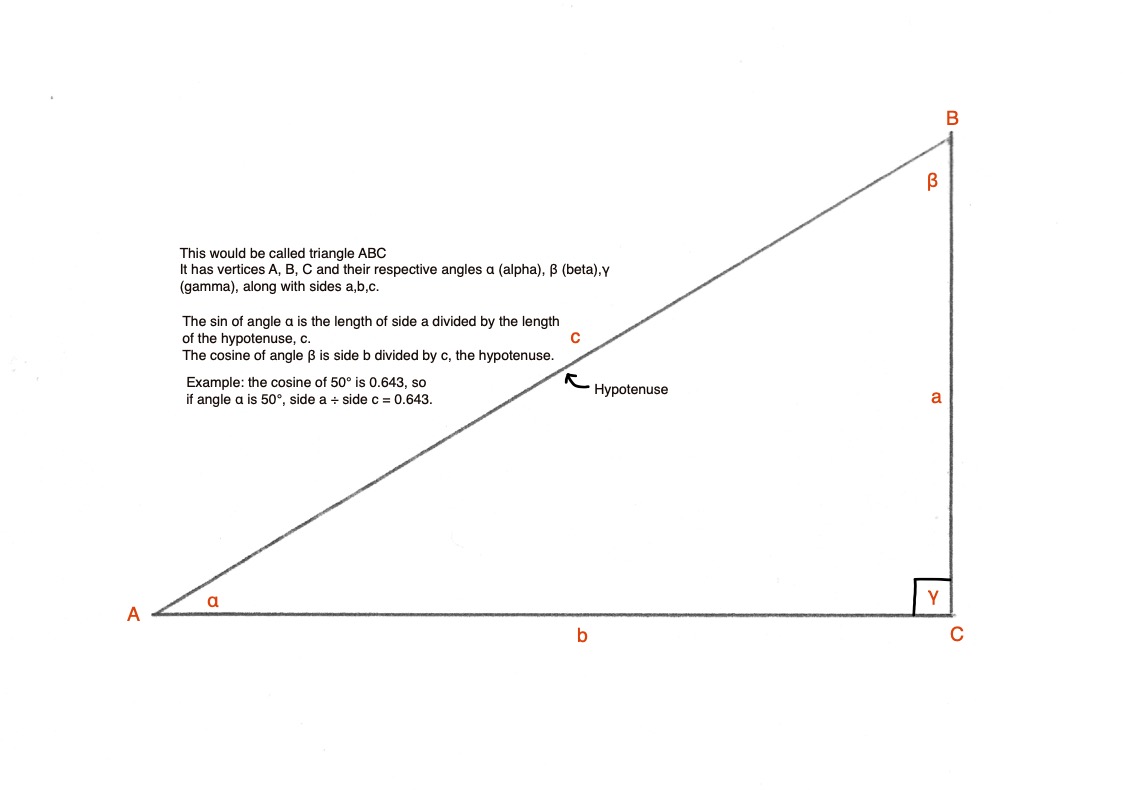
If a triangle is labeled, which is not common in everyday flying, the vertices (corners) are labeled with upper case letters, the side that is opposite a particular vertex, with the same letter, but lower case, and the interior angles with Greek letters corresponding to those letters. Vertex A of triangle ABC would have angle α (alpha) and the side opposite vertex A and angle α is side a.
The triangles most useful to pilots are right triangles, those that have on 90° angle. When drawn, these triangles usually have a small box in the 90° corner to signify its value.
Since the 90° angle has to have the longest side opposite (remembering the 180° sum), that side has a special name, hypotenuse.
The opposite side length for each of the two other angles of any right triangle are directly related to the length of the hypotenuse. In other words, if the angle is known and the length of hypotenuse is known, the length of either the side opposite or the side adjacent to that angle can be found. If an angle is known and any side length, the other side length and the third angle of a right triangle can be found.
Some nomenclature:
Sine is the name for the opposite side ratio length of an angle. It’s often written as “sin”, but is pronounced “s-eye-n”. So, the length of the side opposite angle z divided by the hypotenuse length = the sine of angle z. If angle z is 30°, its sin is 0.5, so if the hypotenuse of the triangle is 25 (miles, feet, knots, or whatever unit), it is equal to 12.5; if the hypotenuse is 10, the opposite side is 5.
Cosine it the name for the adjacent side (the side that is “co”-located with the angle) ratio to the hypotenuse. Adjacent side length of angle z divided by the hypotenuse = cosine.
The tangent isn’t used day-to-day, but is the opposite side divided by the adjacent side.
Figure 1.
A velocity has both a direction and a speed (or magnitude).
The wind is from the northwest (direction).
It’s blowing 15 knots (speed).
It’s reported as 330° at 15 knots (velocity).
A velocity can be broken down into vectors to be more useful. This is often done with wind and is relative to a fixed track across the ground, either a course line or the runway centerline. A wind blowing diagonally from corner to corner across a chess board could be broken down into vectors of 8 squares “cross-board” and 8 squares “down-board”. The pilot is interested in these along track and cross track effects as they relate to the course or runway.
Figure 2.
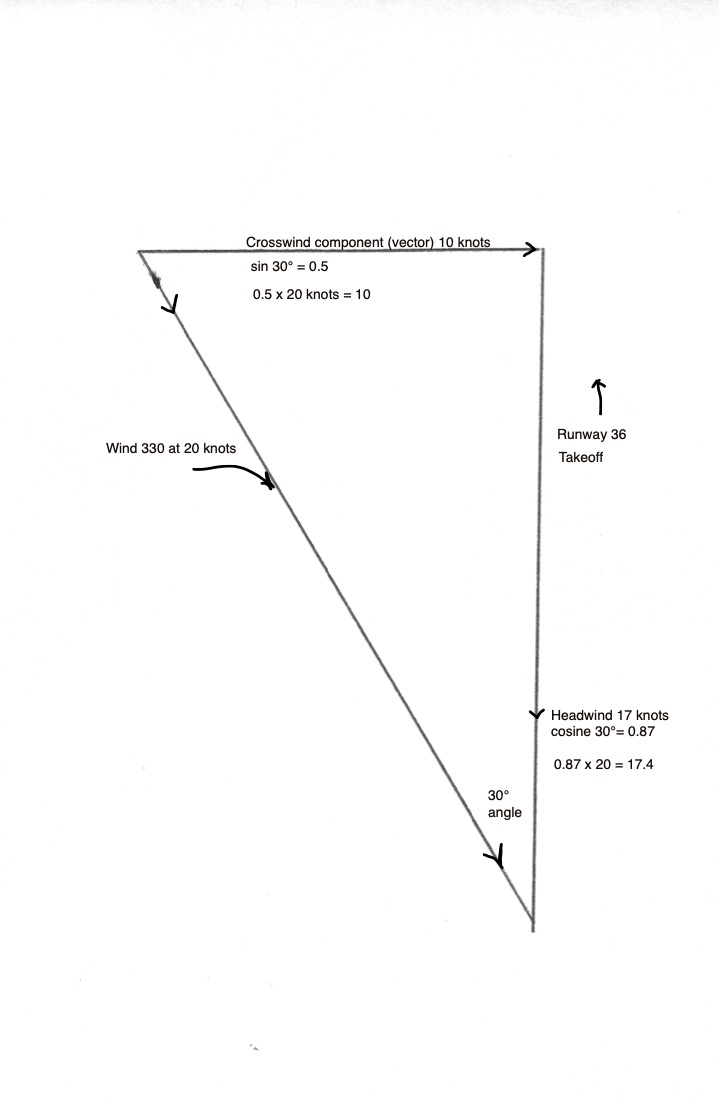
The wind component chart found in Section 5, Performance, of the POH or AFM has done the trigonometry for us. A wind from 30° to the right of the runway centerline at 10 knots has a right crosswind component of 5 knots (the sin of 30° is 0.5) and a headwind component of almost 9 knots (the cosine of 30° is 0.87). If the wind is 60° left of the runway, the numbers would be reversed, 9 knots of left crosswind and 5 knots of headwind. 30° + 60° = 90°, so these angles are complimentary (a sum of 90°), i.e., the sin of one is the cosine of the other. 10° and 80° would be similarly related.
A 45° difference gives the same values for headwind/crosswind component, since the sin and cosine of 45° are the same at 0.71.


