
One winter month, I gave OE to a new first officer, Mark, who had a been a captain at one of the regional subsidiaries. He was brand new to the airline and the Boeing 737, but was an experienced civilian jet pilot.
We met at LaGuardia airport (New York) and were scheduled to fly LGA-MCO (Orlando)-ORD (Chicago O’Hare), layover, then ORD-LGA-ORD-RSW (Ft Myers, FL), layover, then RSW-ORD-LGA.
Although the new pilot does most of the flying on OE, the cka will often fly the 1st leg to let the “student” get settled in. This will probably be the 1st time sitting in the 737 cockpit seat in flight. The controls, switches and dials/screens are exactly the same as in their 40+ hours of simulator training, but the sim only has visual displays (as good as they are), not real windows with the world flying by. So it was my leg to Orlando. On arrival, I demonstrated how to do a “grease-job” (super-smooth landing) in the 737 (Har! Har! You can’t prove I didn’t!).
On to ORD (from the original airport, “ORcharD”). The name O’Hare refers to Medal of Honor recipient Butch O’Hare, Navy ace of WWII. Snow was forecast overnight, but just flurries.
The next day we woke to 3” of snow and it was still coming down. The aircraft was de-iced (snow removed with hot fluid), then anti-iced (a snow-absorbing gel applied which will shear off on the takeoff roll). This was a big delay, so we were quite late when we finally taxied out.
The longer runway was being plowed, so we were sent to runway 33 (which no longer exists). We were leading the pack of airplanes going to 33 and were just short of the runway when the tower said that the condition of the snow covered runway was 2/2/2 (out of 5), which means each 3rd of the runway had braking action/directional control of medium to poor.
That’s what I consider “below average to unsatisfactory”, so I declined the runway. If anything went wrong (engine failure or fire or any system failure that required a rejected takeoff) and I didn’t do everything just right, we could easily be off the side or end of the runway. The safety margin just wasn’t big enough.
After explaining the situation to the passengers, we taxied out of the way to wait for the other runway. When we finally approached the freshly cleared runway 28 Right, two other company 737’s took position in front of us. These were the later ORD-LGA flights.
We departed from a clean runway and were on our way to LaGuardia with Mark doing the flying.
As the flight progressed, I contacted dispatch to see if there was an alternate closer than our filed one of Norfolk, VA (ORF), 300 miles from LaGuardia. There were many airports closer, but they were all going to be subject to the bad weather coming into LGA from the southwest.
When I checked in with New York approach, we heard one of our preceding 737’s call in using the phrase “..back with you.” Huh! They’d done a missed approach and were being vectored back in ahead us.
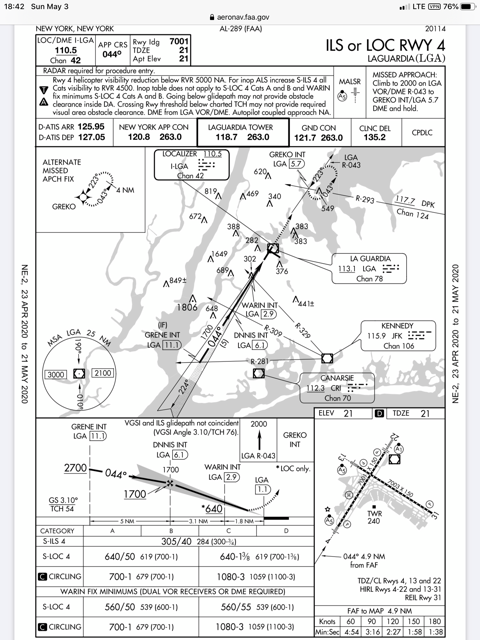
The weather at LGA was 200’ scattered clouds, with more solid layers above that. The approach was to runway 4 (landing to the NE, about 040° course), which had a decision of 300’ above the ground because of a freeway close to the runway precluding a nice approach lighting system (and perhaps some buildings too close). The wind on the ground was a headwind, 100° at 10 knots. We might or might not get/keep the runway in sight when we get to the bottom of the approach. The visibility was good under the clouds.
Meanwhile, the weather was moving in from the southwest (from behind us on the approach). At 2000’, as we began the approach, the wind was 220° at 40 knots (46 mph). So, massive tailwind on approach to a mild headwind on the runway. Hmmmm. Might be interesting…
Mark did a great job flying. We get down to the decision altitude with some ground contact through the scattered clouds, but no runway. The airplane says “minimums”, I say “go-around” and Mark starts the go-around procedure, while commenting, “there’s the runway”. Too late for us, of course, but we take vectors right around for another try.
The next approach ended the same, except for no view of the ground. Decision time: try one more time or get out of town? I’m flying with a new first officer (as outstanding as he is) and the weather is getting worse. So, Norfolk, here we come. We had fuel for another attempt, with fuel to get to ORF with good reserves, but it wasn’t worth trying. And what if there were fuel consuming issues getting to Norfolk?
After we arrive in Norfolk for fuel, I check with dispatch in Fort Worth and learn the weather at LGA will be much better when we get back there. I make a PA explaining the situation, then learn from the flight attendants that a few of the passengers are rather upset: not only are they in Norfolk, not New York, but the flights that pushed back after us at ORD have already gotten to the gate at LGA (with at least one go-around, though).
I fly the uneventful leg to LGA, where the surface wind has shifted and I land to the SW on runway 22. There wasn’t a single tough or interesting decision to make on that leg. A welcome relief.
We flew on to Chicago that evening, never making Ft. Myers due to being so late and the maximum crew duty day limits.
Would I have changed my decision about refusing the snow covered O’Hare runway that others accepted? Do I wish we’d tried that approach into LGA just one more time? “No” on both counts. I’m sure there are passengers who still talk of the horrible flight they had from ORD to LGA, via ORF, though.
It was a pleasure working with such a skilled, well-prepared pilot as Mark on such an interesting day of OE flying.

 kershner flight manuals