
“On short final, we were in light chop and rain, then we had a 10 knot gain, followed by a loss, and when I felt that sink coming on, I called for the go-around and we were balls to the wall getting out of there.”
This phrase has nothing to do with anatomy, but everything to do with getting maximum power to escape a dangerous situation.
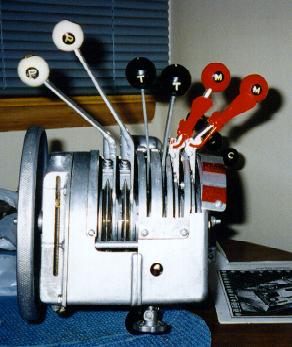
The balls refer to the round knobs on the end of the throttle, prop, and mixture levers on the quadrant of older multi-engined airplanes. The wall is the instrument panel.
An engine produces its most excess thrust horsepower (necessary for climb) when the propellor is at high RPM (low pitch), the throttle is open (pretty obvious), and the mixture control is full rich (at low altitude). These are the full-forward positions for the controls (closest to the “wall”).
Checklists for most light planes* will have the propellor and mixture controls set to full forward as part of the before landing checklist. This doesn’t have much to do with landing, but everything to do with a possible go-around; the plane is configured.
For light planes the most common configuration for controls became (left to right): throttle, propeller, mixture, with colors of black, blue, and red, respectively.
Typical single engine Before Landing checklist:
- Seats- adjusted and locked.
- Fuel- fullest tank
- Mixture- rich
- Propeller- high RPM
- Autopilot- off
Photo a quadrant in the shutdown position: props at high RPM (forward), throttles at idle (back), mixtures at idle cut-off (back). “Wall” in background. This airplane was designed with prop, throttle, mixture, L-R. douglasdc3.com

Below: photo of a quadrant undergoing restoration with the controls in the go-around positions: all forward. douglasdc3.com
*Some of the newest have a single throttle/prop control.

 kershner flight manuals