
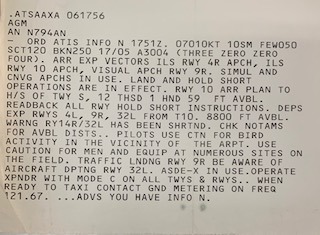
This is a print out of from years ago. The taxiways listed at the very bottom of this post were renamed to align with ICAO standards, which removes local color (no more Chicago taxiway named “Lakeshore Drive”), but makes life much easier for international pilots to understand taxi instructions.
ATIS is “automatic terminal information service”, a system used at larger airports to reduce radio congestion. By telling Chicago Approach Control that AA154 (inbound from Tokyo), has “November” on first contact, they know that we are aware of the latest weather, runways in use or closed, and any notes (birds in vicinity, etc) , so they don’t have to read it to every new airplane on the busy frequency. It can be acquired either over the radio on a discrete frequency or via data link and is generally changed every hour, unless the weather changes dramatically or the runways in use change (“airport turned around”). The next ATIS would be “Oscar” at ORD. Attached is an ATIS printout from my days as a 777 first officer flying out of O’Hare International near Chicago between 2003 and 2012. Since then runways have been built and others closed at one of the world’s busiest airports.
Near the top is the registration number of the airplane, N794AN, which is a Boeing 777-223. The -223 means it’s a -200 model (gross weight of 648,000 pounds with a max fuel capacity of around 303,000 pounds) made for American Airlines, whose customer number is 23. A beautiful flying airplane.
Decoding the ATIS line by line: ORD (O’Hare) information November, time 1751 zulu (GMT) weather. wind from ENE (070°) at 10 knots (12 mph), 10 statute miles visibility, a few clouds at 5000 feet above the field, scattered clouds 12000’ above the field and a broken layer at 25,000’.
Temperature is 17°C (around 63°F) with a dew point of 5°C (41°F), a nice spread, so fog is unlikely to form. The altimeter setting is 30.04 inches of mercury. Putting this into the onboard altimeters will compensate for a slightly high pressure at the field and give accurate readings.
Arrivals expect vectors for ILS (Instrument Landing System) approaches to runway 4 Right, 10 (‘one-zero”) or a visual approach to runway 9 (“niner”) Right.
Simultaneous and converging approaches are being used, so if you go around there may traffic from another runway to be aware of. Land and hold short ops (LAHSO, “lasso”) are being used, so if you’re cleared to land and are told to hold short of a crossing runway/taxiway, and you accept that clearance (i.e., you don’t say “cleared to land runway 10, unable hold short taxiway Sierra”), you are on the hook to stop short or to go around if you see that you won’t be able to comply.
LAHSO is prohibited when there’s a tailwind, the runway’s wet or the ceiling/visibility are low, among a few other things.
Next are the departure runways being used, 4 Left, 9 Right and 32 (“three-two”) Left from taxiway Tango 10, giving 8,800’ available for takeoff. Runway 14R/32L has been shortened.
Watch for birds, men and equipment around the airport, and keep your transponder on while on the ground so they can see where you are via the ASDE-X ground radar.
Departing aircraft contact ground metering when ready to taxi.
One of my first flights as a 727 first officer back in the day: after I called ready to taxi, I listened in slack-jawed wonder as the controller quickly rattled off complex taxi instructions. I had no idea what he’d said or how to read it back. The captain, who knew just where we were to go, laughed and said to me, “Say Roger”.
A few months later it was no sweat when ground said “American 123, 27 Left, Inner, Wedge, Branch, Cargo, follow the JAL seven-four.”, all as fast as you can read that. Whew! Experience goes a long way.

 kershner flight manuals